Why is a surface-applied, low-permeability barrier is superior to a conventional underslab vapor retarder?
| 1. Underslab vapor retarders do a poor job of preventing groundwater intrusion. |
Only under ideal conditions will an underslab vapor retarder prevent the intrusion of groundwater into a concrete slab. Water intrusion can (and often does) occur at column penetrations, joints between sheets, and terminations along foundations and changes in elevation.
Water intrusion can also occur at unrepaired cuts and tears caused by people working on the plastic sheet prior to and during concrete placement. |
 |
Given the way vapor retarders are installed on most jobs, there are usually dozens, if not hundreds of openings through which groundwater can reach the concrete slab.
There is no way to repair these defects once the concrete has been placed. When groundwater has infiltrated behind the unbonded sheet, it is free to make its way anywhere beneath the concrete slab. |
2. Underslab vapor retarders cause problems with concrete finishing and curing.
Concrete finishers dislike vapor retarders, especially when the concrete is placed directly over the plastic sheet. The reason for this is that the vapor retarder forces all bleed water to rise and evaporate from the surface of the concrete. This increases the time required for finishing operations, and also causes problems with drying, shrinkage, cracking, and slab curling.
For this reason, concrete finishers have been known to intentionally puncture the vapor retarder barrier to allow bleed water to drain.
In some cases granular fill is used as a blotter on top of the vapor retarder, but beneath the concrete slab. Unfortunately, this can cause more problems than it solves because the granular fill must be dampened for proper compaction.
When dampened for compaction, 1,000 square feet of granular fill 3" thick may contain 1,250 pounds of water (at ~ 5% moisture content). Since the vapor retarder traps this moisture, it has no place to go but up.
At a moisture emission rate of 3 pounds per 1,000 square feet per 24 hours, this water would take more than a year to dissipate upward through the concrete slab. If it should rain on the granular fill prior to concrete placement, there might be several times this much moisture trapped by the retarder in the granular fill. |
3. Underslab vapor retarders do nothing to control moisture emission from concrete mix water.
A typical cubic yard of concrete with a 6-bag cement factor will contain 564 pounds of cement. At a Water to Cement (W:C) ratio of .45, this yard of concrete will contain 254 pounds of water when it is initially mixed. Of this, approximately 141 pounds (.25 W:C) will be used in the hydration process to form silicate and other hydrates. The remaining 113 pounds of water will linger within the concrete as Water of Convenience (WOC).
One cubic yard of concrete will yield 81 square feet of concrete floor 4" thick. This means that 1,000 square feet of 4" thick concrete floor will contain 1,390 pounds of WOC. If this water leaves the concrete surface in the form of water vapor at a rate 3 pounds per 1,000 square feet per 24 hours, the concrete slab would take 463 days to completely dry.
Although fast track construction is often blamed for concrete moisture emission problems, the truth is that the time required for the slab to dry will almost always conflict with the critical path for building occupancy as a result of concrete mix water alone. Underslab vapor retarders do nothing to control this source of water vapor.
In fact, underslab vapor retarders exacerbate the problem. By preventing moisture from exiting through the bottom of the slab, moisture has only one way of escaping - out the top of the concrete surface. If the underslab vapor retarder is ineffective and there is groundwater or other contributory sources of water beneath the slab, safe levels of concrete moisture emission may never be achieved. |
Solution: A Surface Applied Low Permeability Barrier will control moisture emission no matter what the source.
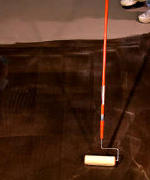
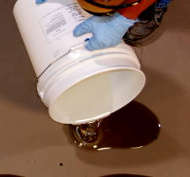
A low permeability surface applied barrier will seal moisture in the concrete regardless of its source, resulting in better and faster concrete cure. This in turn, will result in a dramatic decrease in, if not complete elimination of, concrete drying, shrinkage, and cracking. The effectiveness of a surface applied barrier can be verified and defects identified and repaired any time before the finished flooring is installed.
The Madewell® Permaseal System™ can be installed in as little as 3 days after concrete placement to eliminate alkalinity and moisture vapor emission problems, dramatically reducing drying shrinkage, cracking and slab curling. |
|